
Code
Tree, blob, README
owner/name at HEAD, then directories and files. Markdown renders in the page. Clone URL copies from repo show. Git traffic stays SSH on 2222.
Companion UI
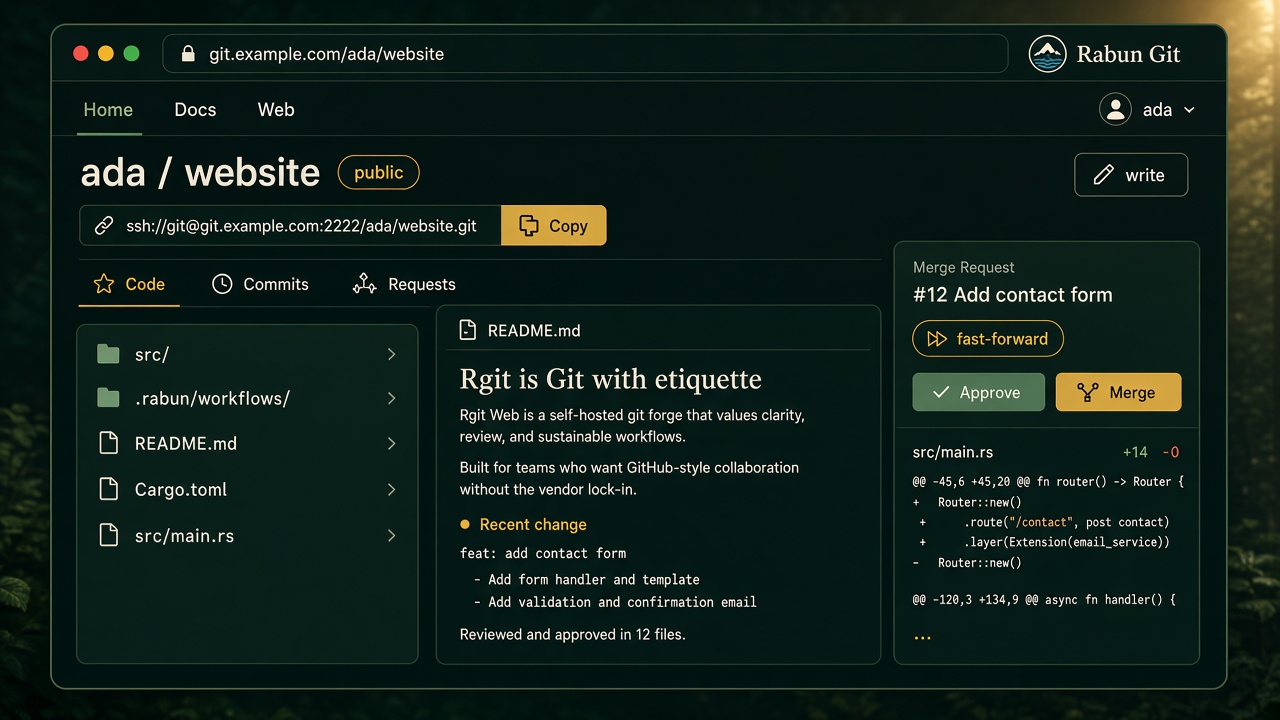
Code
owner/name at HEAD, then directories and files. Markdown renders in the page. Clone URL copies from repo show. Git traffic stays SSH on 2222.
History
Log a ref, open one commit, blame a file line by line, compare two tips. The CLI shells out to git; the website does not keep a second object store.
Review
Same refs as SSH: refs/rabun/requests. Open, comment, approve or reject, fast-forward merge. The website does not invent a second request store.
Read
visibility.yaml marks a repo public. Anonymous browse uses rgit --anonymous. Create, review, and merge still need a signed-in user and the usual roles.
Auth
Web sign-in is argon2id password → bearer token → HttpOnly cookie. SSH clone identity stays public keys. A browser session is not a deploy key.
Rgit Web is a GitHub-style browser for Rabun Git. It is not the forge. rgit serve still listens for git and management commands on SSH port 2222. The website is a separate Bun process that shells out to the same rgit binary with --json.
You can skip it. Teams who live in the terminal already have users, keys, merge requests, and CI. rgit view is enough when you only need a local README and file tree. If you want something else in the browser — cgit, gitweb, a page you wrote — point it at the repos, or at the JSON CLI. Rgit Web is one optional client of that contract, not a gate in front of git.
Signed-out visitors get the public repository list. Signed-in users see the repos their role allows, and can create owner/name. A repository page is /:owner/:name: clone URL, visibility, then tabs for Code, Commits, and Requests.
| Path | What it shows |
|---|---|
/ | Repository list; create when signed in |
/:owner/:name | Tree at HEAD, README when present |
/:owner/:name/tree/:ref/… | Directory |
/:owner/:name/blob/:ref/… | File (markdown rendered; otherwise a pre block) |
/:owner/:name/blame/:ref/… | Per-line blame |
/:owner/:name/commits | Log |
/:owner/:name/commit/:sha | One commit and its diff |
/:owner/:name/requests | Merge request list and open |
/:owner/:name/requests/:id | Show, diff, review, merge |
The hero above is a composed mock of that chrome: cream type on forest cards, gold for public and merge, the same clone URL shape as the user guide. Artistic license — the running app is a bit quieter — but the surfaces are real.
There is no Postgres, no SQLite, no cache of git objects in the web repo. Durable state stays under $RABUN_GIT_ROOT: users.yaml, tokens.yaml, visibility.yaml, bare repos, refs/rabun/requests/*.
The request path is short:
127.0.0.1:3010.Bun.serve matches /api/… or serves the SPA.--token. No cookie becomes --anonymous.rgit --json runs the matching subcommand. Non-zero exit is HTTP 4xx/5xx.Browse payloads come from rgit’s git-extension layer (repo tree, blob, blame, log, refs, diff). Merge is still fast-forward only. The website does not run git itself and does not import the Rust crate.
Clone and push stay public-key SSH. The browser cannot usefully present that key, so web auth is a different door:
rgit user add … --password or rgit user passwd).rgit auth login issues a bearer token (rgit_…). Only a SHA-256 hash is stored.rgit_session cookie (14 days). JavaScript never sees it.rgit auth logout and clears the cookie.People who only clone never need a password. People who review in the browser do.
Two systemd units, one data root. rabun-git.service is User=rabun-git on port 2222. rgit-web.service is User=rgit-web in group rabun-git, loopback 3010, ReadWritePaths on the forge root. Forge ACL still applies: Unix group access is not Operator.
Pack and push is the same air-gapped flow as the CLI. The droplet never talks to GitHub. Details: rgit-web.
Presentation
Rgit Web has no database. Bun holds process config and a cookie that wraps a forge token. Users, ACL, trees, and merge requests live under the forge data root and are reached only by spawning rgit --json.
Backend
Each page load is a clap subcommand: repo list, tree, blob, blame, log, request show. Operators debug with the same commands the website runs.
ACL
The web unit always passes --token or --anonymous. A missing flag would run as Operator and list every private repo. That is a security bug, not a fallback.
Look
Cream, pine, and gold match rgit view and this site. The shell is Burton Bun + React 19, not a Zola build per request.
Replace
cgit, gitweb, a custom SPA, or nothing. The JSON CLI is the contract. Rgit Web is one client.
Optional
rgit serve still does not open HTTP for git. The website is a sibling process. If you never install it, clone, push, and merge requests keep working over SSH and the CLI.
CLI only
Users, keys, requests, and runs from rgit origin … or ssh -p 2222. No browser required.rgit view
Loopback Zola preview of a working copy (or a bare repo on the host). 127.0.0.1:1111. Not a public git UI.Rgit Web
Caddy → Bun on loopback 3010 → rgit --json. GitHub-style chrome for people who want it. Same forge root, different uid.The forge is rgit. Rgit Web is a companion. Source, deploy scripts, and architecture notes live in the rgit-web repo.